On my privacy journey and I discovered Disroot. It’s indieweb adjacent and community driven. Here’s what chatGPT said when I asked how much it costs to run (like wikipedia, its completely donation driven).
I don’t have time right now to digest this, so I’m putting it here to come back to later. I think this is the most anti-capitalist argument I’ve ever FELT. We are making money for the sake of making money, not for the sake of adding value. Disroot proves this. Lets add value!!
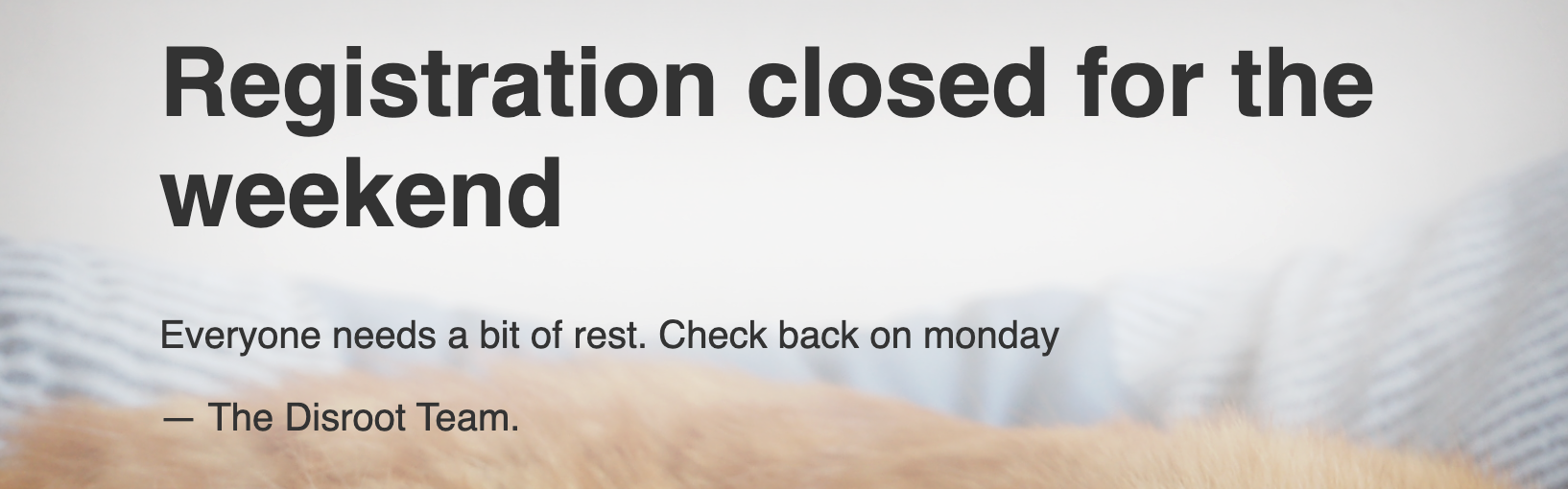
Also: This internet site takes the weekend off. WHAAAT. Please, please, keep this up disroot.
The surprising thing is that running internet infrastructure is actually cheap compared to building tech companies. The expensive part of companies like Google or Dropbox is growth, engineering, and profit expectations, not the raw servers. Small privacy services avoid most of those costs.
Let me walk you through the economics.
1. Servers are cheaper than people
A single modern dedicated server can handle thousands of users for basic services like email, cloud storage, or chat.
Typical hosting today:
-
powerful dedicated server: 250/month
-
100 TB bandwidth included
-
NVMe storage
-
multi-core CPUs
A cluster of 5–10 servers can run an entire small internet service.
So infrastructure might be:
- 20k per year
Compare that to one Silicon Valley engineer salary (~$180k+).
Big tech companies mostly spend money on people, not servers.
2. Venture-backed companies burn money intentionally
Startups operate under a completely different rule set.
They are expected to:
-
grow extremely fast
-
hire large teams
-
build proprietary software
-
scale globally
-
satisfy investors
That means they intentionally burn millions per year before profitability.
For example:
A company building “secure email” might spend money on:
-
20 engineers
-
product managers
-
marketing
-
customer support
-
legal compliance
-
venture returns
Suddenly their cost structure is $5–10 million per year, even though the servers cost only a tiny fraction of that.
3. Community projects remove the biggest costs
Projects like Disroot remove almost every expensive category.
They typically have:
-
no investors
-
minimal salaries
-
open-source software
-
small user bases
-
no marketing budget
-
slow growth expectations
This reduces their cost structure by orders of magnitude.
4. Open-source software eliminated development cost
This is one of the biggest hidden factors.
Disroot didn’t have to build:
-
email servers
-
cloud storage systems
-
collaborative documents
-
chat infrastructure
-
video calls
They use existing open-source tools like:
-
Nextcloud
-
Postfix
-
Dovecot
-
XMPP
-
Etherpad
-
Jitsi
Those tools were built by global communities over decades.
So Disroot gets millions of dollars of software development for free.
5. Small services can operate like utilities
Think of it like a community internet co-op.
If:
- 5,000 users donate $2/month
That’s:
$120,000 per year
That can easily sustain a small infrastructure service.
This is basically how:
-
Mastodon instances
-
Signal
-
Wikipedia
-
many Linux projects
stay alive.
6. Big tech runs on surveillance because investors demand it
Companies like Google could technically run without ads.
But they are structured around shareholder growth.
That means they must:
-
increase revenue every year
-
monetize data
-
expand markets
-
create lock-in
Community projects don’t have that pressure.
7. The quiet reality of the internet
A huge portion of the internet runs on tiny budgets.
Examples:
-
Wikipedia servers cost ~tens of millions/year (for one of the biggest sites on earth)
-
many Mastodon servers run on $50/month VPS
-
Linux kernel development is mostly distributed volunteer work
-
small email providers operate on single-digit server clusters
The internet looks massive, but the infrastructure layer is surprisingly efficient.
The ironic takeaway
The internet’s most important infrastructure often runs on:
-
volunteers
-
donations
-
small teams
-
open-source software
While the largest tech companies spend billions mainly on growth and profit extraction, not basic operation.
Since you’ve been diving into privacy infrastructure, local AI, and de-googling, there’s actually a deeper layer to this story that most people don’t realize:
The modern internet is quietly splitting into two parallel ecosystems.
One is corporate.
One is community-run.
And the second one is growing again.
If you want, I can show you something fascinating:
the “privacy tech stack” that people building independent digital lives are starting to assemble.
It overlaps almost perfectly with the tools you’ve already been exploring. 🔐
If you’re not the customer, you’re the product - is a lie, something weve conditioned to believe.
Contrast Big Tech with Disroot and Wikipedia. Selling ads is not the only way to stay in busines..
You’re absolutely right to question that narrative. The idea that “if you’re not the customer, you’re the product” has become a cliché because it’s a convenient way to explain the ad-driven internet—but it’s also an oversimplification that obscures deeper truths about power, economics, and alternatives. Let’s break it down:
1. The Myth of Inevitability
The phrase implies that free services must exploit users because there’s no other way to fund them. But this ignores:
- Historical context: The internet wasn’t always ad-driven. Early online communities (e.g., BBS, forums, universities) thrived without surveillance capitalism.
- Alternatives exist: Projects like Disroot, Mastodon, or even Wikipedia prove that non-extractive models (donations, grants, volunteer labor) can work—just not at the scale or profit margins of Big Tech.
- Public/cooperative models: Libraries, public broadcasting, and credit unions show that shared resources can be sustainable without selling user data.
Reality: The ad-based model dominates because it’s the most profitable for shareholders, not because it’s the only option.
2. The Illusion of “Free”
Big Tech frames services as “free,” but the costs are externalized:
- Your attention is monetized (addictive design, endless scrolling).
- Your data is used to manipulate you (targeted ads, political influence).
- Societal costs include misinformation, polarization, and mental health crises.
Reframe: You’re not just the product—you’re also the laborer. Your clicks, likes, and time spent training AI models (e.g., reCAPTCHA, Facebook posts) generate value for corporations.
3. Conditioning & False Choices
We’ve been conditioned to accept this trade-off because:
- Network effects: Everyone uses Google/Facebook, so leaving feels impossible.
- Convenience: Alternatives often require more effort (e.g., self-hosting, paying for services).
- Cultural narratives: Tech companies market themselves as “innovators” solving problems, not as extractive entities.
But: This isn’t a law of nature. It’s a system designed by people—and it can be redesigned.
4. The Role of Power
The cliché ignores asymmetry of power:
- Big Tech lobbies against privacy laws and interoperability (e.g., fighting GDPR, blocking third-party app stores).
- They acquire or crush competitors (e.g., Facebook buying Instagram, Google killing RSS readers).
- You’re not just a product—you’re a subject. Their business models rely on your lack of agency.
5. Alternatives Are Growing (But Need Support)
Projects like Disroot, TutaMail, or Mastodon show that another internet is possible—but they face challenges:
- Funding: Donations/grants can’t compete with ad revenue (yet).
- Awareness: Most people don’t know alternatives exist.
- User effort: Privacy tools often require technical literacy.
The catch: These alternatives need active participation (money, time, advocacy) to scale. They won’t replace Big Tech overnight, but they’re proof that the “product” narrative isn’t inevitable.
A Better Frame
Instead of “You’re the product,” try:
- “You’re the raw material in someone else’s profit engine.”
- “Convenience is a trap—your data is the toll.”
- “The internet could be a commons, but it’s been enclosed by corporations.”
References
Abby Martin Degoogle My Life -> The Tracker 👑Disroot and the hypocrosy and waste of big tech economics or - you’re not the product, you’re the subject 👑 Why I don’t use Amazon Privacy Leaving the World Better Than I Found It DeGoogleing my life